
Leaders: Your jar has more than one label
In this article:
- Why leaders need to think about the different ‘labels for their jar’ – the different ways they need to show up and communicate in different contexts.
- Why it’s still the same jar – it’s not about being all things to all people, it’s about having a strong foundation in a well-developed leadership brand or identity, and gaining clarity on how to articulate value to different audiences.
- Typical examples of the different brand ‘labels’ senior leaders think about – for the board, the executive team, as an industry or market representative, in leading their teams.
- The difference between your Comms/PR plans and scripts, and developing a foundational leadership brand.
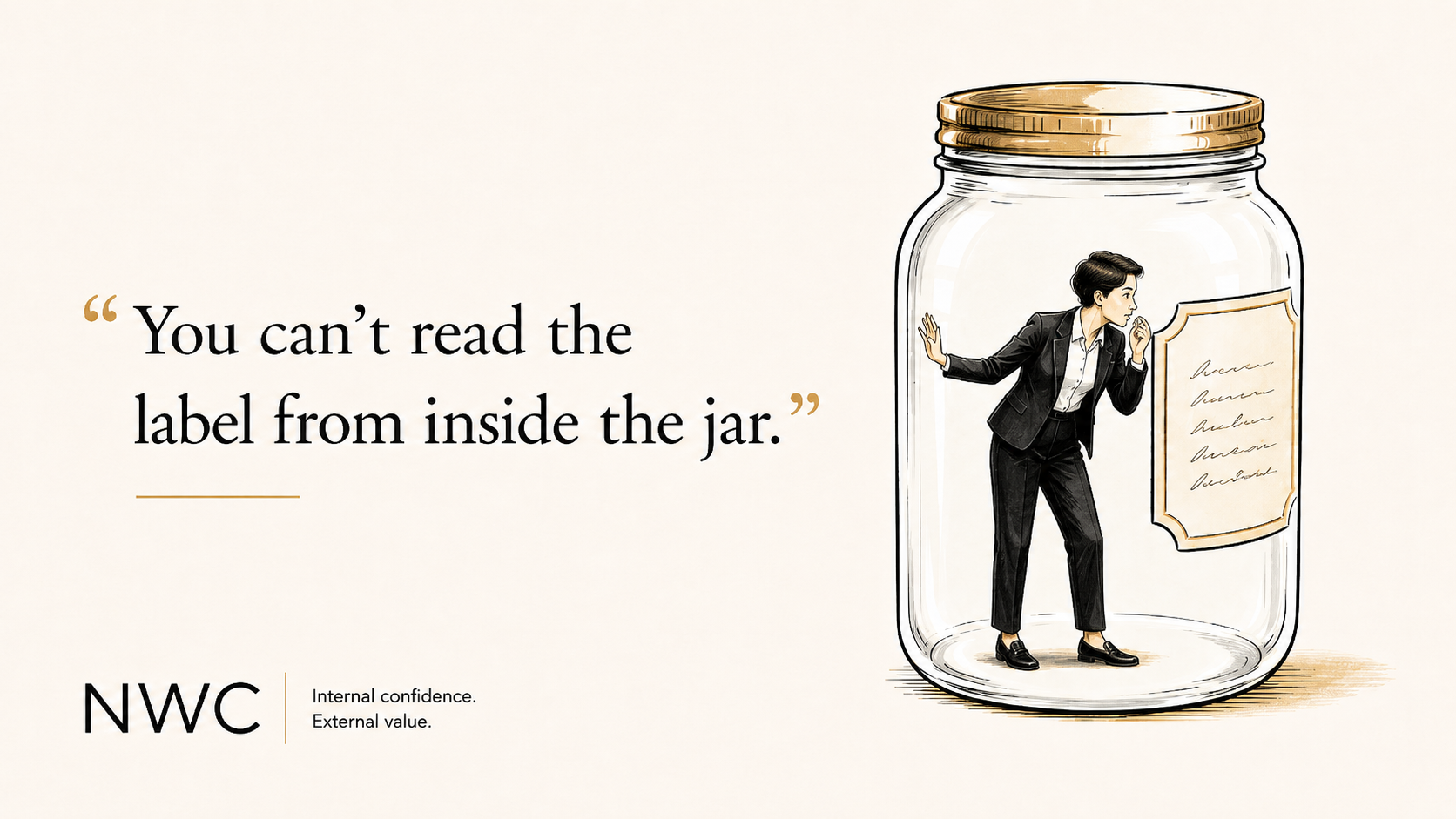
In a previous post, I wrote about the trouble of reading your own label from inside the jar — the perspective problem that makes it hard for even the most accomplished leaders to see themselves the way others do.
Say a leader does that work, arriving at genuine clarity about who they are and what they bring.
Job done? Not quite. The jar has more than one label.
The board sees a strategist. The executive team sees a decision-maker. The market sees a name and a track record. The people you lead see someone else again.
Same jar. Same contents. Different label, depending on who’s reading it.
Isn’t that just being inauthentic?
I hear this worry often. Leaders assume the only honest position is showing up in the same way, to everyone, and that if the message shifts by audience, it’s over-manipulated.
In fact, it’s the opposite. Speaking with relevance to a specific audience is a mark of leadership maturity – a signal that you are concerned with what the particular people in front of you need. It’s not a compromise of identity if communication is shaped from this place.
A board wants governance judgement, risk appetite, strategic oversight.
An executive team wants to know how you make decisions under pressure, day to day.
The market wants a clear, credible account of value.
Your organisation’s people want to see vision, values and direction.
None of that is contradictory. It’s the same leadership identity, translated for what each audience actually needs to know.
The real work is holding one clear, well-defined foundation while communicating with precision across audiences who each need something different from it. That’s the balancing act for senior leaders: stay clear on who you are, and stay flexible on how you say it.
“That’s the real balancing act for leaders: stay clear on who you are, and stay flexible on how you say it.”
One identity, not several scripts
Sometimes I get asked: “Is leadership branding the same as having a leadership communication plan? Our Comms and PR people take care of the comms plan and scripts.”
This is not the same thing. Leadership brand development is about clarifying who you are, what you do, how you do things, and why it matters… and it’s often connected to the company purpose, values, vision and direction. While it touches on some of the same communication challenges, it is really the foundation – the leader getting clear on their identity within the context of their organisation and career.
It is not a script. It’s the internal confidence and external value positioning in how the leader shows up every day, guides and responds, creates opportunities for themselves and others, connects with others and brings them along. A powerful bedrock for effective leader communication is strong leadership brand development.
“Not the same as having a comms plan or script… Leadership Brand development is a powerful bedrock for effective leader communication.”
The internal layer, a leader’s purpose, values and leadership philosophy, stays constant. It doesn’t change depending on who’s in the room. The external layer is where the translation happens. Get it right, and a board bio, a town hall introduction and a LinkedIn profile all sound like the same person, addressing entirely different priorities. Get it wrong, and a leader either flattens into one generic message that satisfies no one, or fragments into several versions that fall apart the moment two audiences compare notes.
One of my clients, the CEO of an NFP who also holds Non-Executive Director roles elsewhere, came to this work because her LinkedIn profile and personal brand were reading as an extension of the organisation she runs, when what she needed was a leadership brand distinct enough to stand on its own, balancing her roles as a director and mentor in other rooms.
Leaders who manage this well have usually done the foundational work first: getting precise about what they stand for, before working out how to express it to each stakeholder group. Skip straight to the external messaging without that foundation, and the disconnect is what you get.
Knowing which label is showing
Part of this is practical. A leader walking into a board meeting straight after a difficult executive team conversation needs to know which version of themselves the room is expecting, and to show up as that leader without it feeling like a performance.
This isn’t about having a different persona for every room. (If it were, you’d need an acting coach, not a brand advisor.) It’s about understanding, precisely, what each audience needs from the same underlying leader, and being deliberate about which parts of that identity to bring forward.
Do this work, and you stop feeling pulled between conflicting identities. It starts to feel like one leadership brand, with several accurate expressions (and if you tackle this as a leadership group, it’s even more powerful!).
Your jar has more than one label. The work is making sure every one of them is telling the truth.
Further reading
Confidence, Trust and Stronger Human Identity in an AI World
Executive reputation management and AI searches