
Someone is already writing your leadership label
In this article:
- Why a leader’s reputation is being shaped externally, whether they participate in that process or not
- The specific forces doing the writing: media coverage, LinkedIn’s algorithm, AI-generated summaries, search results, speculation around senior role and board movement
- Why “I don’t really do social media” is no longer a neutral position
- How to move from a passive subject of your reputation to an active author of it, without becoming consumed by managing it
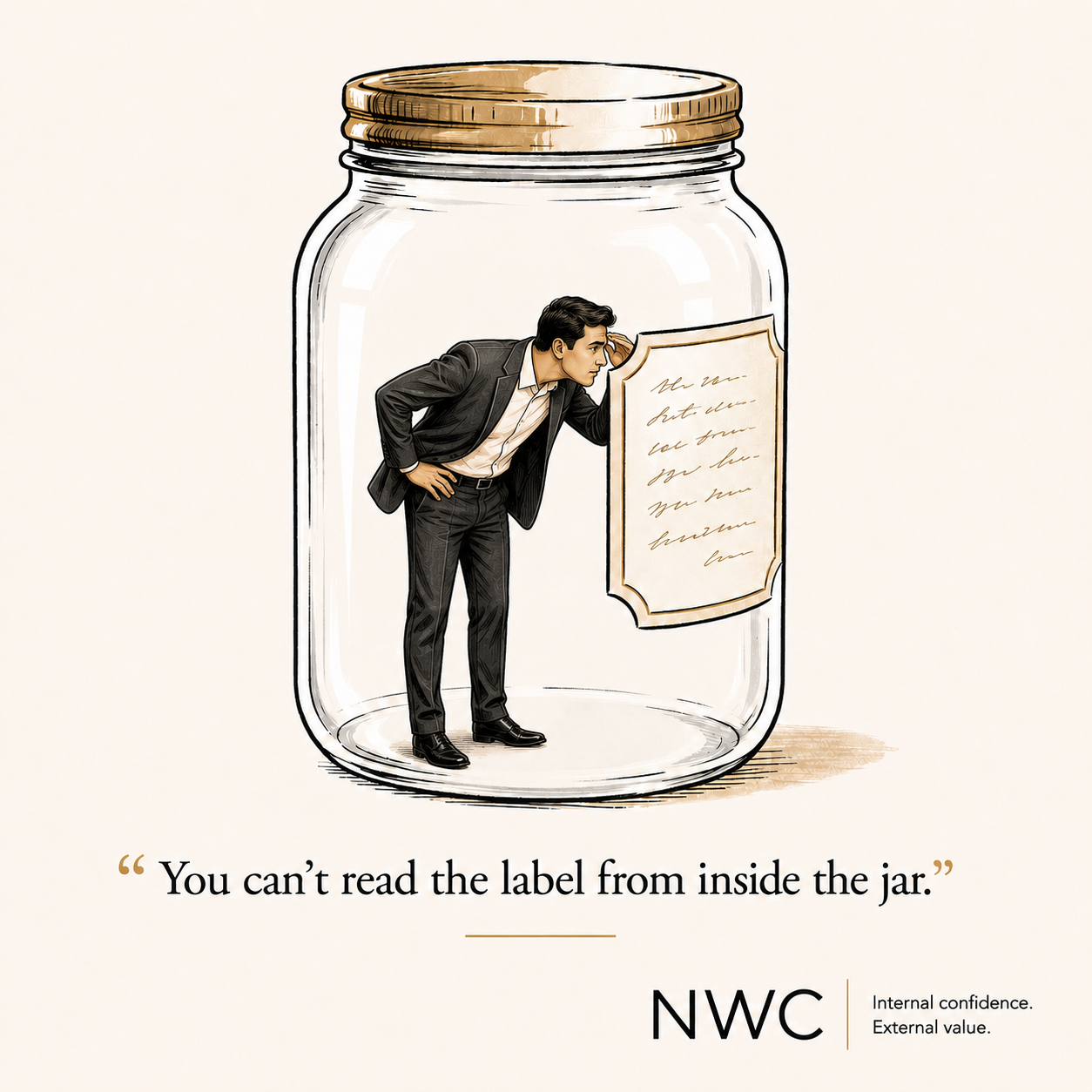
I’ve written before about the difficulty of reading your own label from inside the jar, and about the fact that most senior leaders are managing more than one label at once, for different audiences who each need something different from the same underlying identity. Both of those pieces assume the leader has some hand in the writing. This one is about what happens when they don’t.
A label gets written whether a leader participates or not. Board searches run candidates through search results before a single conversation happens. Journalists compile a leader’s public footprint before an interview. Increasingly, AI tools summarise a person’s professional standing from whatever is publicly available, and that summary carries weight with people who will never meet the leader it describes.
“I keep a low profile, so this doesn’t really apply to me”
I hear a version of this often, usually from leaders who see visibility as unnecessary or even a little indulgent. It’s a reasonable instinct. Good work should speak for itself, and there’s something admirable about not needing to perform relevance.
The trouble is that a low profile doesn’t mean no profile. It means an unmanaged one. Search results still surface, old media mentions still exist, a sparse or years-stale LinkedIn presence still leaves an impression, and AI-generated summaries still get produced from whatever fragments are available. Not participating doesn’t pause the process. It just means someone, or something, else has more influence over the outcome than the leader does.
What’s doing the writing
A handful of forces shape a senior leader’s external label with very little input required.
Media coverage, even brief or years old, tends to surface prominently and stays there indefinitely. A single quote from a difficult period can outweigh a decade of steady leadership if it’s the most substantial thing search engines can find.
A LinkedIn profile that hasn’t been touched in years reads as stale regardless of what the algorithm rewards this month, so a leader who was active three years ago and has gone quiet since can appear less current, or less senior, than their actual standing.
AI-generated summaries compress whatever is publicly available into a single confident-sounding paragraph, with no visible indication of how thin or dated the underlying sources might be.
Speculation fills gaps around senior movement. Whenever an executive changes roles, joins a new board, leaves a company or is simply due for a move, market commentary and assumption step in wherever there’s an absence of clear, current information. Those assumptions are rarely as accurate, or as flattering, as the leader would choose for themselves.
None of this is inherently hostile. Most of it is simply automated, incomplete, or built for someone else’s purposes entirely.
From subject to author
The shift that matters here isn’t from invisible to loud. It’s from passive to intentional. A leader who has done the foundational work of leadership brand development, getting genuinely clear on their identity, value and positioning, is in a far stronger position to shape how that gets represented externally, because they have accurate, current material to work with rather than leaving the record to fill itself in.
One client, a CEO stepping away from an operational role into a portfolio of Non-Executive Director positions, came to this work after realising that anyone searching his name found almost nothing from the past five years, despite it being the most consequential stretch of his career. The gap wasn’t a reputation problem so much as an information vacuum, and it was working against him at exactly the moment he needed his track record to be visible to new boards.
Another client came to me in a genuine panic. Years earlier, as part of a leadership coaching program, she had been filmed giving a testimonial she felt pressured into delivering, one that never reflected her real experience. The clip was then used repeatedly in the program’s marketing, and it had settled at the top of her search results just as she was stepping into a highly visible senior role. The version of her that a search engine served up first was not the leader she needed the market to see, and it took real work to change what that search told people about her.
“The version of her that a search engine served up first was not the leader she needed the market to see.”
This connects directly to the themes we explored in our National Leadership Study on professional confidence in the age of AI: leaders who have clarity on their own value are far better placed to maintain that value as more of the work traditionally done by humans is taken on by AI tools. The Leadership Brand Framework we use with clients treats this as one layer of a broader picture, not a standalone fix, because a well-managed LinkedIn profile built on a shaky foundation is still a shaky foundation, just a more visible one.
Writing the label doesn’t mean managing it constantly
This isn’t a case for leaders to spend their evenings monitoring search results or posting daily to stay algorithmically relevant. (That doesn’t sound to me like a productive use of a senior leader’s time!)
It’s a case for making sure the material that exists, a positioned bio, a current and accurate LinkedIn profile, a small number of substantive public statements about what a leader stands for, is accurate and recent enough that it can do the work on their behalf. Get that foundation right, and a leader doesn’t need to manage their reputation day to day. The record simply reflects them accurately when someone goes looking.
Someone is already writing your label. The only real choice is whether you’ve had a hand in it.