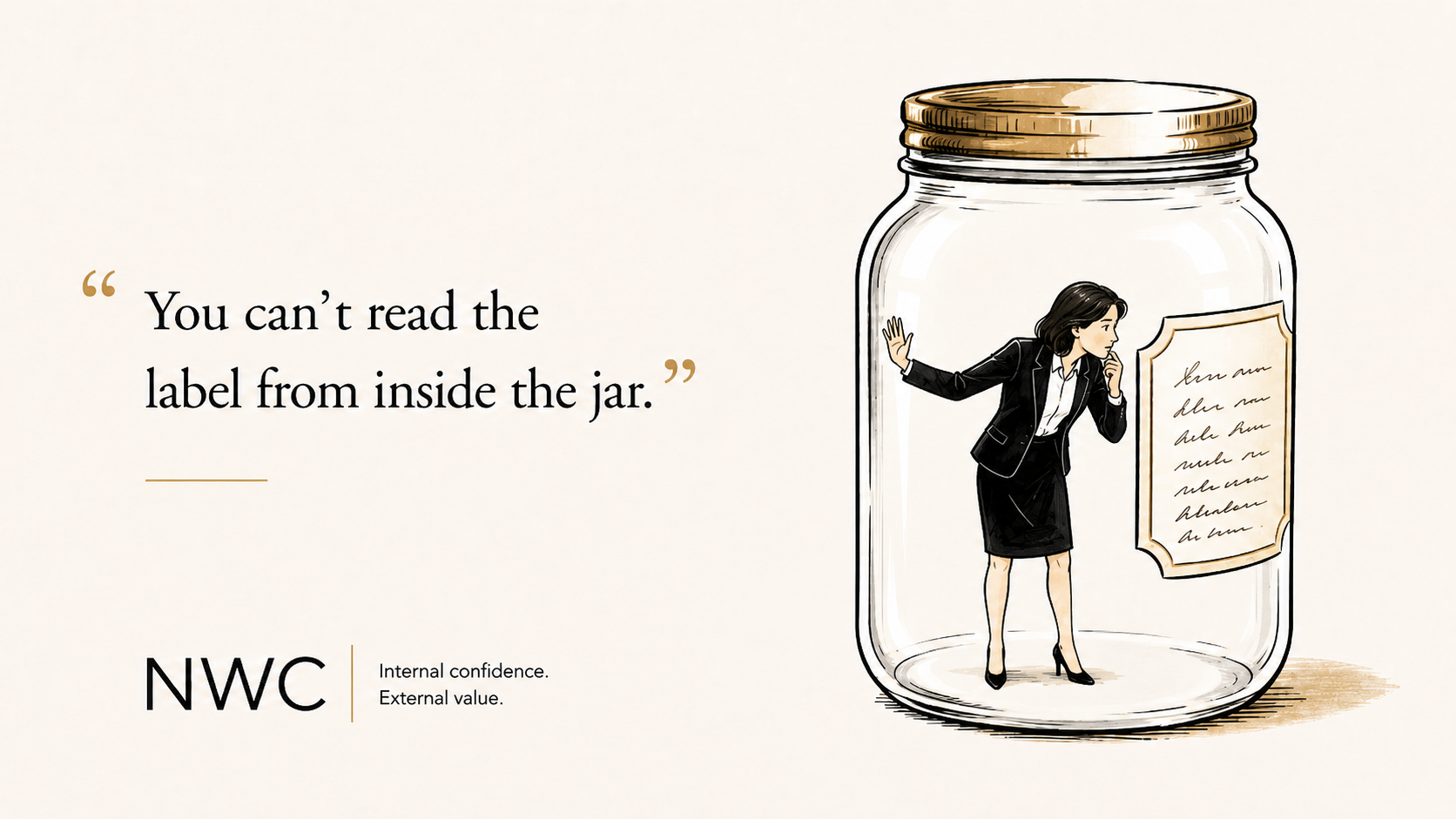
You can’t read the label from inside the jar: Why leaders want personal brand development
The senior leaders I work with are not short on substance. They have run divisions, sat on boards, built teams, navigated crises and delivered results that took real judgement under pressure. What’s harder for them is stepping outside that experience to see it the way someone else would.
That is the ‘inside the jar’ problem we all have. From inside, you know the contents intimately, every ingredient, every reason it works. But you cannot read your own label, because you are looking at the world from the inside out, not the outside in.
This is not a confidence problem as much as it is a perspective problem. It is precisely why leadership brand work matters at this level, even for people who have spent decades being very good at their jobs.
Knowing and articulating are different skills
Expertise accumulates quietly. A leader’s value proposition does not arrive in a single moment of clarity; it builds across hundreds of decisions, conversations and outcomes, most of which were never written down or named. By the time someone reaches the C-suite or a board table, they are operating from a depth of judgement they rarely have to explain, because the people around them already understand the context.
That changes the moment they need to communicate that value to someone new: a board considering them for a director role, an introduction to staff as the new CEO, a market they are entering, a stakeholder group deciding whether to trust them. Suddenly the unspoken needs to become spoken – precisely, and with impact.
Reflection is the most undervalued leadership tool
The biggest roadblock to clearly communicated positioning is the leader’s lack of time and structure to access and apply their insights. Senior roles run at a fast pace, where there is rarely space for the kind of slow, deliberate reflection that produces real clarity about who you are and what you stand for.
This is where an outside perspective creates real value and efficiency for senior executives. Not to tell a leader who they are, but to ask the right questions in the right order, to notice patterns they cannot see because they are too close to them, and to hold up something like a mirror so they can read their own label from the outside for the first time.
The shift is more than language
The leaders who go through the leadership brand development process do not just end up with a better bio or a sharper LinkedIn profile, although those things follow. They end up standing differently in a room. Once someone has genuine clarity about the value of their work to specific audiences and can articulate it without hesitation, that clarity shows up in how they negotiate, how they present to a board, and how they introduce themselves at a conference where they do not know a single person in the room.
This is the real return on the work: it’s not just polish, but a leader who has the precise language and the authentic confidence that matches the substance they were already carrying.
In a market increasingly crowded with generic, AI-assisted content, that precision is also a point of genuine differentiation and a risk mitigator. The leaders who stand out are not the ones saying the most; they are the ones saying exactly what is true about them, in a way that resonates deeply with their intended audience.